
The Pakistan government has blocked a resolution moved in the UN Security Council for imposing sanctions against former Inter-Services-Intelligence chief retired Lieutenant General Hamid Gul over his alleged links with al-Qaeda and Taliban, Prime Minister Yousuf Raza Gilani said on Wednesday.

Former Pakistani Inter Services Intelligence boss Hamid Gul was brought under the radar on Monday by the Delhi police after arrested Lashkar-e-Tayiba 'bomb expert' Abdul Karim Tunda revealed that he was in touch with him.

Just why is Pakistan's former spy chief among the most dangerous men in the world?
Pakistan's hardline Islamist general Hamid Gul, known for nurturing militants in Kashmir and Punjab and Afghanistan during his stint as chief of the powerful ISI, has died following a brain haemorrhage.
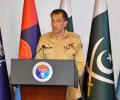
Lt Gen Ahmed Sharif Chaudhry, the spokesperson for the Pakistan Army, is the son of a nuclear scientist who was sanctioned by the United Nations and the US for providing information and expertise to al-Qaeda, according to Indian officials. Chaudhry's father, Sultan Bashiruddin Mahmood, allegedly provided insights into nuclear weapons infrastructure and raised funds for a fundamentalist organization linked to the Taliban. Mahmood was arrested in 2001 after admitting to meeting Osama bin Laden but was later released.

Former Inter Services Intelligence chief Lieutenant General. Hamid Gul responds to charges that he supports terrorism, discusses 9/11 and ulterior motives for the war on Afghanistan, claims that the US, Israel, and India are behind efforts to destabilise Pakistan.
The United States on Wednesday dismissed as 'false and outrageous' the allegations made by former Inter-Services Intelligence agency chief Hamid Gul that the United States government was involved in the assassination of former premier Benazir Bhutto.Noting that Gul had 'repeatedly asserted the outrageous and baseless claim' during appearances on two TV news channels, a spokesman for the US embassy said, "The US rejects this and other false allegations."
"The kind of terrorism, which is going on in Pakistan, is due to Kashmir issue," Hamid Gul, the former head of the Inter Services Intelligence (ISI) who is also believed to have created Kashmiri militants groups claimed in the CNN's Connect the World programme.

'A psychological moment will be created when the Kashmiris will say they can't live with either India or Pakistan. At that time, America will step in and suggest a democratic solution to Kashmir,' former ISI chief Hamid Gul tells Sheela Bhatt.
Former ISI chief Hamid Gul said Musharraf has not stated in his memoirs that Washington was behind his military coup.
About informing Haq three weeks prior to the Bahawalpur incident, Hamid Gul said that a report from ISI was submitted to him that Haq should restrict his movements.
The Lashkar-e-Tayiba's global mission is quite extensive something the West has now begun to realise. Many now assess the LeT to be a bigger eventual threat than the Al Qaeda because the Lashkar has state sponsorship, says Vikram Sood.
Amidst the celebrations over dreaded terrorist Osama bin Laden's killing, some political figures have passed statements that they really should not be making.
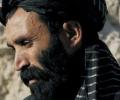
Afghan Taliban leader Mullah Mohammad Omar has reportedly been killed in Pakistan, an Afghanistan private television channel has reported.

A former director-general of Pakistan's Inter-Services Intelligence has said that United States President Barack Obama will pull out American troops from Afghanistan for economic reasons rather than for strategic ones because his administration would find the ongoing surge unsustainable.
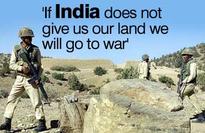
'India will give its land when it will be divided into many pieces,' warns former ISI chief Hamid Gul.
Pakistan President Pervez Musharraf, Commander of 4 Corps (Lahore) Lt Gen Mohammed Aziz and Chief of General Staff Gen Mohammed Yusuf had run a proxy war in Jammu and Kashmir in the early 1990s, a new book has claimed.
Former Inter-Services-Inetlligence chief Hamid Gul on Sunday dismissed as "nonsense" reports that Pakistan has agreed to arrest and hand him over to India in connection with the probe into the Mumbai terror attacks.

Violations from the Pakistani side along the Line of Control have become a common recurrence, and according to sources in the Intelligence Bureau, some peace can be expected only after Pakistan Army Chief Gen Ashfaq Parvez Kayani retires next month.
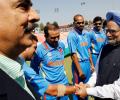
22 images that captures glimpses of a most unusual Indian who led the nation for 10 years.

'Bhutto feared elements of the so-called establishment, including people linked to the intelligence services. She highly distrusted individuals like Hamid Gul who -- she was convinced -- maintained active ties with jihadists.' Heraldo Munoz, author of the sensational new book, Getting Away With Murder, tells Rediff.com's Vicky Nanjappa in an exclusive interview.

The vice-president will be the second Indian to be accorded the honour at the Oxford Centre for Islamic Studies. Nikhil Lakshman reports.

Top Lashkar-e-Tayiba bomb expert Abdul Karim Tunda told interrogators that he had come in contact with Pakistan's spy agency Inter Services Intelligence after meeting former ISI Chief Hamid Gul in 1995 and was in constant touch with him thereafter.
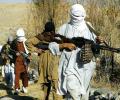
Pakistan National Security Advisor Sartaj Aziz brings to New Delhi a newfound Pakistani confidence, stemming from its leverage in Afghanistan, says Ajai Shukla

A computer has helped scientists discover the largest prime number ever with over 22 million digits, breaking the previous record by approximately 5 million digits.

The attacks on Karachi airport and the Airport Security Force camp are growing signs how Pakistan's home-made monster, the Tehreek-e-Taliban Pakistan, is growing stronger and is no longer under the tight grip of the Inter-Services-Intelligence, its godfather. Vicky Nanjappa reports how these attacks are just the beginning and there are many more to come.

'A close look at the time-lines tells you that exactly as the back-channel negotiations were in their most crucial stage, "somebody" was planning the 26/11 attacks in Mumbai,' says Shekhar Gupta questioning Khurshid Mahmud Kasuri's account of a peace deal with India.

General Asad Durrani's disclosures could leave considerable egg on the face of those currently wielding the stick in Pakistan, notes Rana Banerji, who headed the Pakistan desk at the Research and Analysis Wing, India's external intelligence agency.

'Why has the rhetoric gone down on the Indian side, Durrani wondered aloud.' 'I said because almost total normalcy and peace had returned on the ground in Kashmir,' recalls Shekhar Gupta. 'The general gave me that career spook's laser look. And he said: "That situation on the ground can change in no time".' 'This was precisely when the Pakistanis began their first incursions into Kargil.' 'Durrani had been retired for five years.' 'But once the ISI boss, you are always in the know.'
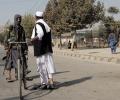
Pakistan would want to take full advantage of the situation to direct Taliban trained terrorists into the Kashmir Valley, alert Lieutenant General Ashok Joshi (retd) and Colonel Anil A Athale (retd).
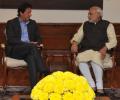
Should India engage Pakistan's generals directly, bypassing Imran? Ambassador G Parthasarathy, India's former high commissioner to Pakistan, ponders Delhi's diplomatic dilemma.

'India can replicate what Pakistan did to Kulbhushan Jadhav should the need arise.' 'Hopefully, Pakistan will see reason before that transpires,' says Ambassador G Parthasarathy, former high commissioner to Pakistan.
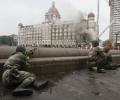
Through its early days to the 1980s, Pakistan sought to expand its sphere of Islamic influence through Afghanistan to Central Asia and got Pakistani citizens recruited in the Afghan government institutions in the 1990s when the Taliban were power. Now, it is looking eastward through India to Bangladesh and Myanmar to establish an imaginary caliphate.

These releases are in addition to 26 Taliban detainees freed last year by Pakistan.
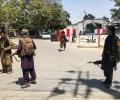
Despite dependence on the ISI for years of sustenance, Taliban leaders may harbour resentment over the ISI's excessive control, notes Rana Banerji, who headed the Pakistan desk at the Research and Analysis Wing.

The question really is whether the US can be persuaded to embark on a path of calibrated and stronger sanctions on Pakistan.

The India card is now almost obsolete. There are more pressing challenges. People of Pakistan are fed up with years of bad governance, corruption and broken promises of successive governments. However, the politicians and former generals are still provoking sentiments on what is happening on the Line of Control for petty political gains, says Shahzad Raza.

'Jaish aided by LeT attacked Parliament knowing mobilisation of Indian military assets would be the consequence.' 'That mobilisation happened, necessitating a military response from Musharraf who moved troops guarding back doors out of Tora Bora, facilitating Osama's escape.'

Pakistani teenager and Nobel Peace Prize winner Malala Yousafzai has been conferred with the Liberty Medal, and the youngest recipient of the American award said this will encourage her to continue her campaign for child rights in countries including India.
